
Bedroom Sizes Guide: Average Bedroom Size, King Size Bedroom & Standard Dimensions Explained
- DreamDen AI Editorial Team
- Apr 2
- 4 min read


Choosing the right bedroom size is more important than most people realize. Whether you are designing a new home, remodeling your space, or simply planning furniture placement, understanding bedroom dimensions helps you avoid costly mistakes and create a comfortable, functional space.
Bedroom sizes are not random. There are common standards followed by builders and designers that ensure a room can comfortably fit a bed, storage, and walking space. Once you understand these sizes, it becomes much easier to plan your layout and choose the right furniture.
What Is the Average Bedroom Size ?
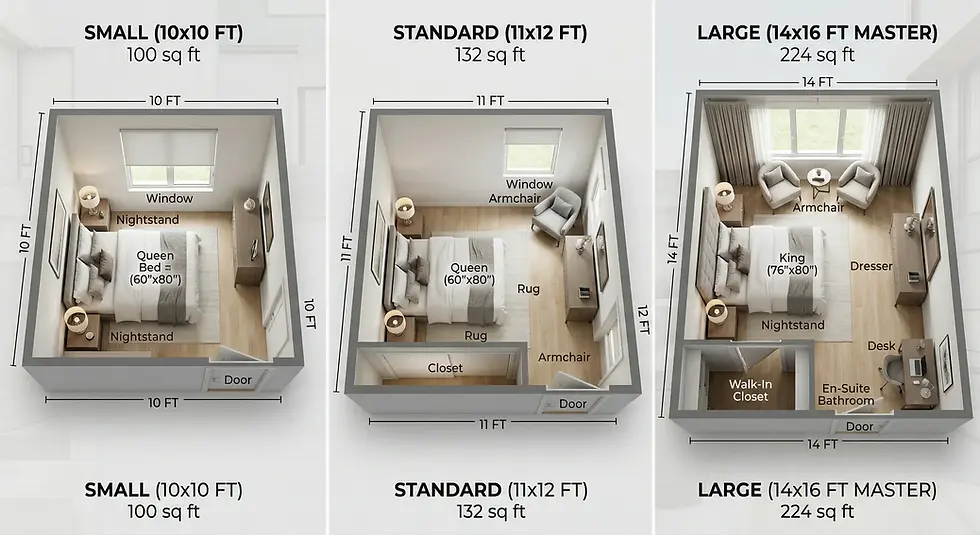
The average bedroom size in the United States is around 132 square feet, which typically translates to a room measuring about 11 × 12 feet.
This size is considered ideal for a standard bedroom because it provides enough space for a queen-size bed, nightstands, and basic storage without feeling cramped. Most modern homes follow this layout because it balances comfort and efficient use of space.
However, not all bedrooms are the same. Secondary bedrooms, guest rooms, and kids’ rooms are often slightly smaller, usually around 120 square feet, while larger homes may include more spacious layouts.
The key idea here is simple: a bedroom should feel comfortable to move in, not just fit a bed.
Standard Bedroom Size: What Is Considered “Normal”?
When people talk about a “standard bedroom size,” they are usually referring to a range rather than one exact number.
In most American homes, a standard bedroom falls between 100 and 150 square feet, with common dimensions like 10×10, 10×12, or 12×12 feet.
These sizes are popular because they work well with typical furniture layouts. A room in this range can easily accommodate a full or queen-size bed, a dresser, and still leave enough walking space for comfort.
Designers often focus not just on size, but on how the space is used. Even a smaller bedroom can feel spacious if the layout is planned properly, while a larger room can feel crowded if furniture is not arranged well.
King Size Bedroom: How Big Should It Be?

A king size bedroom is usually part of a master or primary bedroom, and it requires significantly more space than a standard room.
On average, a master bedroom in the measures around 14 × 16 feet (224 square feet).
This size is ideal because a king-size bed itself is large, and you still need space for:
Nightstands on both sides
Walking clearance
Additional furniture like dressers or seating
Experts generally recommend at least 12 × 12 feet (144 sq ft) as a minimum for comfortably fitting a king-size bed, but larger rooms provide a much better experience.
This is why modern homes are increasingly designed with bigger primary bedrooms, as people now use bedrooms not just for sleeping, but also for relaxing, reading, and even working.
Why Bedroom Size Matters More Than You Think

Many homeowners underestimate the importance of bedroom dimensions. But the size of your room directly affects comfort, functionality, and even how your home feels overall.
A bedroom that is too small can feel restrictive, making it difficult to move around or add storage. On the other hand, a well-sized bedroom allows for better furniture placement, improved lighting flow, and a more relaxing environment.
Another important factor is clearance space. Designers recommend leaving at least 2–3 feet of walking space around the bed to maintain comfort and usability.
Without proper spacing, even a large bedroom can feel uncomfortable.
How to Choose the Right Bedroom Size for Your Needs

Choosing the right bedroom size depends on how you plan to use the space. If the room is only for sleeping, a smaller layout may work perfectly. But if you want additional features like a workspace, seating area, or large wardrobe, you will need more space.
For most homeowners, a standard bedroom works well for daily use, while a larger master bedroom provides comfort and flexibility. The key is to match the room size with your lifestyle, not just follow general standards.
Instead of guessing, it is always better to visualize your layout before finalizing your decision.
A Smarter Way to Plan Your Bedroom Layout

One of the biggest challenges people face is imagining how a bedroom will actually look once everything is placed inside. Measurements on paper often do not translate clearly into real-life space.
This is where visualization tools make a big difference.
With DreamDen AI, you can see how different bedroom sizes, bed types, and furniture arrangements will look in your actual space. Instead of relying on assumptions, you can make decisions based on a realistic preview.
This approach helps you avoid common mistakes like choosing the wrong bed size or overcrowding your room.
Final Thoughts
Understanding bedroom sizes is the first step toward creating a comfortable and functional space. The average bedroom size in the U.S. provides a solid starting point, while standard and master bedroom dimensions offer flexibility depending on your needs.
A king size bedroom offers luxury and space, but it requires proper planning to work effectively. At the same time, even a smaller bedroom can feel perfect with the right layout.
The most important thing is not just the size of the room, but how well it is designed.


Comments