
Knob-and-Tube Wiring

Updated: Apr 7
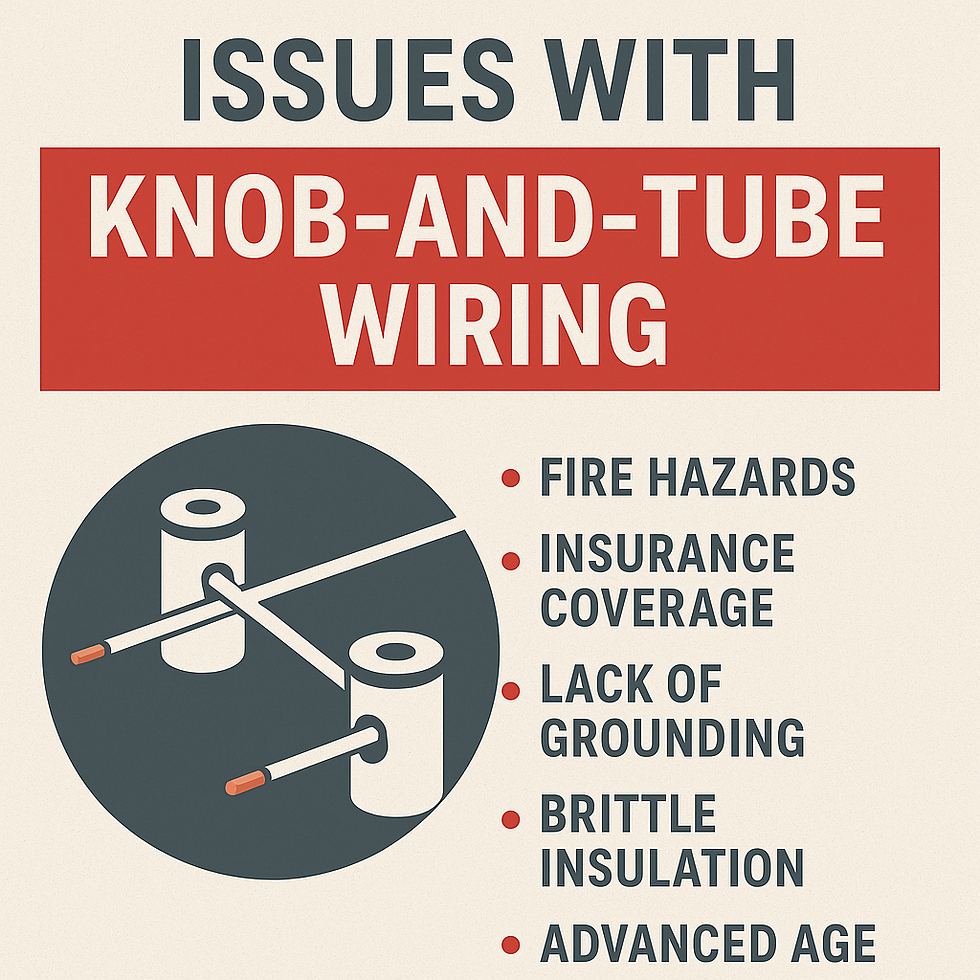
Knob-and-tube wiring remains one of the most common legacy electrical systems found in older homes across the United States, particularly in regions with historic housing stock such as Massachusetts, New York, Pennsylvania, and parts of the Midwest. Installed from the 1880s through the early 1930s, this wiring method represented state-of-the-art technology for its time. Today, however, it presents a number of safety, insurance, and usability concerns that homeowners must understand.
This blog explains:
What knob-and-tube wiring is
Why it was used historically
The top five issues and risks associated with it
How insulation affects safety
Why insurance companies often refuse coverage
The dangers of ungrounded electrical systems
How aging materials contribute to failures
Why replacement is often the best long-term solution
Important considerations when hiring an electrician for rewiring
Common misconceptions and homeowner FAQs
1. What Is Knob-and-Tube Wiring?
Knob-and-tube (K&T) wiring is the first generation of standardized residential electrical wiring used in the United States. It consists of:
Single hot and neutral conductors run separately through the structure
Porcelain knobs used to support wires on framing
Porcelain tubes used to protect wires passing through wood
Open-air installation, allowing heat to dissipate naturally
K&T installations were designed at a time when:
Electrical loads were extremely low
Homes contained only a few lighting circuits
Appliances were minimal or nonexistent
Grounding conductors were not yet introduced
Insulation in wall cavities was uncommon
Because of these factors, K&T wiring functioned effectively for decades. However, modern electrical demands and building materials have made this wiring style outdated and, in many circumstances, unsafe.
2. Historical Context and Lifespan
Knob-and-tube wiring was installed primarily from 1880 through approximately 1932. BX (armored cable) became the second generation of wiring beginning around 1905, and both systems coexisted for nearly three decades.
The age of existing K&T wiring today ranges from:
90 years old at minimum
Up to 140 years old at maximum
Considering the natural degradation of materials, increased electrical demand, and evolving safety standards, the wiring has far exceeded any reasonable service lifespan.
3. The Top Five Issues With Knob-and-Tube Wiring
Although several concerns exist, the following five represent the most significant risks.
Issue #1: Insulation and Heat Dissipation Problems
Knob-and-tube wiring was engineered to be installed in open air. This allowed heat generated by electrical current to dissipate safely.
Modern home insulation creates a direct conflict.
Why This Matters
When insulation surrounds K&T conductors:
Heat can no longer dissipate properly
Conductors overheat
Insulation on wires breaks down faster
Fire risk increases significantly
Current Regulations
In states such as Massachusetts, MassSave and other energy-efficiency programs require homes to be free of active K&T wiring before insulation can be installed. An electrician must:
Inspect the home
Confirm all K&T circuits have been de-energized or replaced
Sign a compliance form before insulation contractors proceed
If active K&T remains, insulation work cannot legally continue until replacement is completed. This is considered the number one safety risk associated with knob-and-tube wiring.
Issue 2: Insurance Companies Often Refuse Coverage
Knob-and-tube wiring significantly affects homeowner insurance eligibility.
Insurance Industry Concerns
Insurance companies frequently decline coverage due to:
Increased fire risk
Lack of grounding
Age-related deterioration
Difficulty verifying condition inside walls and ceilings
Homeowner Impact
Policies may be:
Denied outright
Canceled after inspection
Approved only with a premium surcharge
As a result, many homeowners face a choice:
Replace the K&T wiring, or
Switch to a specialty insurer at a much higher cost
This issue is widespread and one of the leading reasons homeowners pursue rewiring projects.
Issue 3: Lack of Grounding and Related Safety Hazards
Knob-and-tube wiring is ungrounded, containing only a hot and neutral conductor. Grounding was introduced later as a critical safety feature to protect both occupants and equipment.
Consequences of Ungrounded Systems
Appliances with metal frames can become energized
Fault conditions may not trip breakers
The risk of electrical shock increases
Surge protection is ineffective
Modern devices with grounding plugs are incompatible
Real-World Scenario
A classic example demonstrates the danger:
A refrigerator connected to a circuit improperly extended from K&T wiring
The added outlet included a grounded conductor, but since the originating K&T system had no ground, the breaker never tripped
A fault between the hot wire and ground energized the metal frame of the appliance
Touching the fridge and another grounded object created a shock hazard
With modern wiring, a short between hot and ground would trip the breaker instantly. In K&T systems, it may not — because the grounding path does not exist.
This makes ground faults and shock hazards significantly more dangerous in homes with unmodified knob-and-tube systems.
Issue 4: Brittle Wire Insulation and Material Degradation
K&T wiring used rubber-based insulation, which naturally deteriorates over time due to:
Heat from lamps and fixtures
Environmental temperature changes
Mechanical stress
Oxidation and aging
Signs of Insulation Breakdown
Insulation crumbles when touched
Bare copper conductors become exposed
Wires crack or flake during fixture replacement
Short circuits become more likely
Old light fixtures amplify the problem. Many early fixtures lack insulating barriers, and homeowners frequently used 100-watt bulbs — far exceeding the fixture’s design rating. The continuous heat literally “cooked” the wire over decades.
Once the insulation fails, repairs become difficult or impossible without replacing entire segments of wiring.
Issue 5: The Wiring Is Extremely Old
Knob-and-tube wiring is now nearly a century or more old. Age alone introduces multiple risks:
Conductors loosen from porcelain knobs
Splice insulation deteriorates
Connections corrode
Mechanical damage accumulates
Previous modifications compromise integrity
Even well-installed systems cannot be expected to function safely after 90–140 years.
Most experts consider K&T wiring to have fully exceeded its service life, and replacement is strongly recommended even if no immediate failures are visible.
4. Why Improper Modifications Make K&T More Dangerous
Many hazards arise not from the original installation, but from later alterations performed by:
Homeowners
Handymen
Inexperienced electricians
Renovators or contractors
Common — and Unsafe — Modifications
Extending modern Romex cable from K&T circuits
Installing grounded outlets without proper grounding
Hidden junctions buried behind walls
Splicing without junction boxes
Mixing wire types
Such modifications violate electrical code and create unsafe conditions that often go undetected until failure occurs.
5. Understanding the Fire Risk
K&T wiring has several characteristics that increase fire potential:
Insulation breakdown leads to exposed conductors
Ungrounded circuits allow faults to persist without tripping breakers
Added insulation prevents heat dissipation
Old splices and solder joints loosen over time
Overloaded circuits were not designed for modern appliances
Although K&T wiring performed adequately when originally installed, modern home usage patterns far exceed its intended capacity.
6. Why Replacement Is Usually Recommended
In most cases, complete replacement of all active knob-and-tube wiring is the safest option.
Benefits of Replacing K&T Wiring
Fully grounded circuits
Increased electrical capacity
Compatibility with modern appliances and electronics
Improved fire safety
Eligibility for standard homeowner insurance
Ability to insulate walls and attics safely
Peace of mind knowing wiring meets modern standards
Replacement is a significant project, but the long-term safety and financial benefits outweigh the effort.
7. What Homeowners Should Expect During a Rewire
Replacing K&T wiring is a specialized task. Electricians experienced in rewiring older homes know how to minimize disruption while ensuring safety.
Typical Steps in a Rewiring Project
Electrical assessment and mapping of existing K&T circuits
Creation of a rewire plan, including new circuit layout
Strategic placement of holes to fish new wires through walls
Replacement of light fixtures, switches, and outlets as needed
Installation of grounded wiring systems and modern breaker protection
Removal or disconnection of all active K&T wiring
Testing and verification of all new wiring
Repair of access holes by a finish carpenter or drywall contractor
Experienced electricians use minimally invasive techniques and understand the structure of older homes.
8. Choosing the Right Electrician for Knob-and-Tube Replacement
Knob-and-tube rewiring is not a standard electrical task. Homeowners must choose a contractor who specializes in older home rewires.
Key Qualifications to Look For
Extensive experience with K&T rewiring
Familiarity with building structures from the 1800s–1930s
Ability to minimize wall and ceiling damage
Knowledge of code requirements for ungrounded circuits
Understanding of insulation and safety compliance programs
Transparent pricing and documentation
Proper licensing, insurance, and permitting practices
Hiring an inexperienced contractor can result in:
Excessive holes and unnecessary property damage
Unsafe wiring or code violations
Incomplete removal of active K&T
Increased long-term repair costs
Rewiring a home with aged wiring is a high-skill specialty, and must be treated accordingly.
9. Additional Misconceptions About Knob-and-Tube Wiring
Misconception 1: K&T wiring is illegal
It may be obsolete, but it is not illegal unless altered improperly or made unsafe by modifications.
Misconception 2: K&T wiring must be removed entirely
It must be de-energized or replaced where active, but dead wiring can be left in place.
Misconception 3: Adding a grounded outlet fixes grounding issues
Grounded outlets cannot be installed on ungrounded K&T circuits unless certain code-compliant alternatives are used (e.g., GFCI receptacles with labels).
Misconception 4: If K&T is working, it’s safe
Age, deterioration, and modern loads create hidden hazards regardless of current functionality.
Frequently Asked Questions (FAQ)
1. Does knob-and-tube wiring need to be removed?
Active sections must be removed or replaced to comply with insurance and safety standards. Dead wiring may remain if properly abandoned.
2. Can insulation be added around K&T wiring?
No. This is unsafe and prohibited in most jurisdictions unless the wiring is first replaced.
3. Why won’t my insurance company cover my home?
K&T wiring increases fire risk, and ungrounded circuits pose safety hazards. Many insurers simply exclude homes with active K&T wiring.
4. Can knob-and-tube wiring be repaired instead of replaced?
Small repairs may be possible, but most systems are too degraded to justify patching. Replacement is the long-term solution.
5. How long does a rewire take?
Depending on home size, complexity, and access, a full rewire may take from several days to several weeks.
6. How do I know if my home still has active knob-and-tube?
Signs include:
Porcelain knobs and tubes in the basement or attic
Cloth-covered wiring
Two-prong outlets
Wiring running through open air
Electrical systems known to be original or pre-1930
A licensed electrician can verify.
7. Is K&T wiring always dangerous?
It is dangerous when:
Covered by insulation
Modified by unqualified persons
Exposed to moisture or heat
Degraded or brittle
Overloaded by modern electrical demands
Even in good condition, it lacks grounding and is obsolete.
Summary: Why Knob-and-Tube Wiring Should Be Replaced
Knob-and-tube wiring represents an important part of electrical history, but it is not compatible with modern living standards. Its primary risks include:
Fire hazards from insulation contact
Ungrounded circuits and shock dangers
Insurance coverage complications
Brittle insulation and material deterioration
Advanced age and structural vulnerability
Homeowners should consider full replacement performed by qualified electricians who specialize in rewiring older homes. Doing so improves safety, insurability, and overall electrical performance.



Comments