
Design a Small Bedroom with AI: When You Have No Space to Experiment
- DreamDen AI Editorial Team
- Mar 6
- 7 min read


A 10×12 room sounds workable on paper. That's 120 square feet. Enough for a bed, a dresser, maybe a small desk. But when you actually try to arrange it, you discover that the door swings into the bed frame, the dresser blocks the closet, the desk only fits in the corner that gets no light, and every configuration you try makes the room feel smaller than the last one.
You rearrange, stand back, decide it's worse, move everything back, and try a slightly different angle. Repeat until you give up or throw out your back.
Why Small Bedrooms Are So Hard to Get Right

There's a physics problem at the core of small bedroom design that most people don't consciously recognize: in a small room, every decision is interconnected. Move one piece and everything else must shift. Choose one oversized item and the entire room is compromised.
The Door Swing Problem
A standard bedroom door requires a 30–36 inch clearance arc to open fully. In a 10×12 room, this single architectural constraint eliminates a significant percentage of available floor space and immediately rules out several furniture placement options — often without the homeowner realizing it.
The Traffic Flow Trap
Every person needs at least 24 inches of clearance to walk comfortably beside furniture. In a small bedroom, maintaining this clearance on both sides of the bed while also accessing the closet, dresser, and door often feels geometrically impossible — because it frequently is, with the wrong furniture sizes.
The Scale Illusion
A king bed in a 10×12 room doesn't leave enough clearance on either side.
A tall 6-drawer dresser dominates a small wall and makes the ceiling feel lower. Scale errors are the most common and most expensive mistakes in small bedroom design — because you usually discover them after purchase and delivery.
The Storage Dilemma
Small bedrooms need more storage per square foot than large bedrooms — because small homes typically have fewer storage options elsewhere.
The solution requires a fundamentally different approach to storage: vertical, built-in, under-bed, and multi-functional pieces that a traditional bedroom setup doesn't use.
How DreamDen AI Approaches Small Bedroom Layout
When you upload a photo of your small bedroom to DreamDen AI, the platform doesn't apply a generic small-room template. Then it generates layout options that are calibrated to your room — not an idealized version of it.
What DreamDen AI Analyzes in a Small Bedroom
Actual usable floor area (after door swing and fixed feature exclusions).
Window placement — natural light direction and view access
Closet door type and clearance requirements (swing vs. sliding vs. bi-fold)
Outlet and light switch positions that constrain furniture placement
Ceiling height — affects vertical storage recommendations
Room proportions — square vs. rectangular vs. irregular layouts
Existing furniture scale vs. room dimensions
Traffic flow paths between all entry/exit points
4 Small Bedroom Layout Options AI Generates for a 10×12 Room
To make this concrete, here are the four primary layout configurations DreamDen AI evaluates for a standard 10×12 bedroom — complete with floor plan diagrams, best-use conditions, and the AI's reasoning for each.
Room dimensions: 10 feet wide × 12 feet deep. Door on the 10-foot wall (left side). Single window on the 12-foot wall (opposite the door). Closet on right side of 10-foot wall.
LAYOUT 1: CENTERED COMMAND — Classic symmetry — maximum breathing room

✓ WORKS WELL WHEN… • You want equal access on both sides of the bed • The room is used by two people • You want the most balanced, spacious feel • The window is centered on the far wall | ✗ AVOID WHEN… • You need a desk or workspace in the room • Ceiling is low — centered layout emphasizes width over height • You have a bi-fold closet that needs full clearance on the right |
LAYOUT 2: CORNER ANCHOR — Maximizes floor space — frees a full wall

✓ WORKS WELL WHEN… • One person sleeps in the room • You need a workspace or desk • You want to maximize usable floor area • Storage is a priority over symmetry | ✗ AVOID WHEN… • Two people share the bed — wall-side sleeper has no exit • You have a window on the corner wall • You prioritize equal nightstand access |
LAYOUT 3: WINDOW FOCAL — Natural light maximized — photogenic and airy

✓ WORKS WELL WHEN… • Natural light and airy feel are the priority • The window view is worth showcasing • You want the most photogenic, magazine-worthy layout • The room has a low ceiling (window emphasis draws eye out) | ✗ AVOID WHEN… • Window is a drafty single-pane (cold sleepers avoid) • Window lets in early morning sun (light sleepers) • Window wall has a radiator — clearance required |
LAYOUT 4: STORAGE-FIRST — When function beats everything — small room, big life
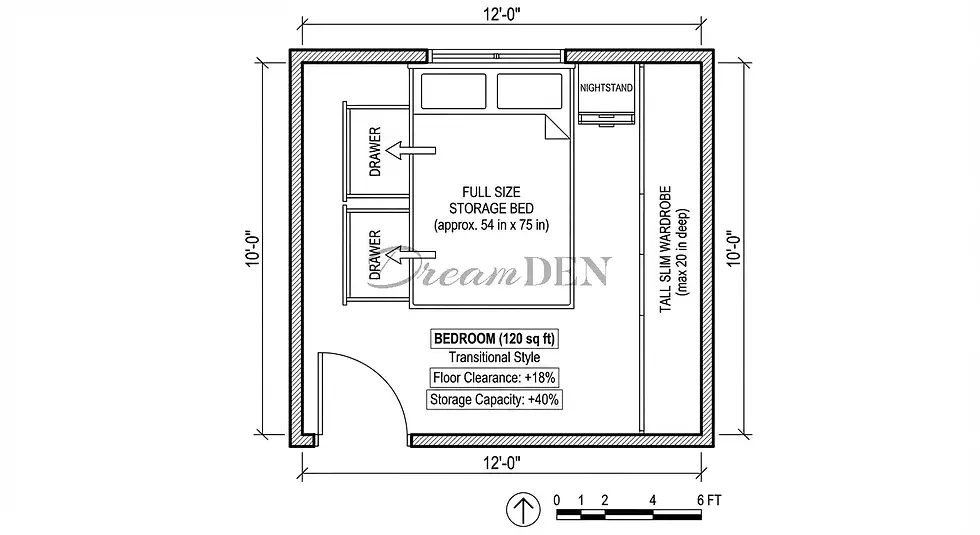
✓ WORKS WELL WHEN… • The room doubles as an office or multi-use space • Storage is severely limited elsewhere in the home • Solo occupant willing to use a Full rather than Queen • You're optimizing for floor space above comfort | ✗ AVOID WHEN… • Two people share the bed — Full is too small for couples • Storage is adequate elsewhere and comfort is the priority • You want the room to feel relaxing, not efficient |
The AI-Recommended Furniture Scale Guide for a 10×12 Bedroom
Here are the furniture sizing guidelines DreamDen AI applies when designing a 10×12 small bedroom — and the space-saving alternatives it recommends when standard sizes won't fit:
Furniture Piece | Recommended Max Size | Space-Saving Alternative | AI Placement Tip |
Bed (primary) | Full (54"W) or Queen (60"W) | Full XL or Murphy Bed | Position with 24" clear on access side(s). Wall-side placement only for solo occupants. |
Nightstand | 16"–18" wide max | Wall-mounted floating shelf | Float 2–4" above mattress height. Wall-mount saves ~3–4 sq ft of floor space. |
Dresser | 30"–36" wide, max 48" tall | Tall narrow wardrobe (20" deep) | Place on shortest wall. Never block window or closet door swing arc. |
Desk | 40"–48" wide, 20"–24" deep | Wall-mounted fold-down desk | Corner placement or dedicated desk zone freed by corner-anchor bed layout. |
Wardrobe / Armoire | 36"–42" wide, 20" max depth | Reach-in closet organizer | Place flush to wall. Sliding doors preferred over swing doors to preserve clearance. |
Bench / Ottoman | 36"–42" long at bed foot | Storage ottoman (24"–30") | Only if bed-foot clearance exceeds 36". Storage version doubles as seating + chest. |
Bookshelf | 24"–30" wide, floor-to-ceiling | Floating wall shelves | Vertical shelving maximizes storage without consuming floor area. Use corners. |
The 7 Small Bedroom Mistakes AI Catches Before You Make Them
These are the most frequent errors DreamDen AI flags when analyzing small bedroom photos — all preventable with AI visualization before purchase or arrangement:
The Mistake | What Actually Happens | What AI Does Instead |
King bed in 10×12 room | Zero clearance — can't walk around it | Recommends Queen or Full with 24" clearances shown |
All furniture against walls | Room feels like a waiting room | Generates floating arrangement with conversational flow |
Tall dark furniture on short wall | Ceiling feels lower, room feels caved-in | Suggests low-profile pieces or light-finish tall storage |
Standard dresser blocks closet | Every morning is an obstacle course | Calculates door swing arc and keeps it clear |
Matching set from one collection | Uniform height/scale makes room monotonous | Mixes heights for visual rhythm and space efficiency |
Dark paint in an attempt to be bold | Small room reads as a cave, not a cocoon | Recommends deep color only with high-ceiling + good light |
Rug too small for bed size | Bed looks like it's floating on a postage stamp | Sizes rug to extend 18–24" beyond bed on 3 sides |
Small Bedroom Design Questions Answered
Does DreamDen work for rooms smaller than 10×12?
Yes. DreamDen handles rooms of any size, including very small spaces under 100 square feet. The AI's layout recommendations become even more targeted in extreme small-space conditions — recommending Murphy beds, loft configurations, and multi-function furniture that standard bedroom guides don't address.
Can the AI design a bedroom that also functions as a home office?
This is one of the most common use cases since 2020. The AI treats dual-function rooms differently from sleep-only rooms — prioritizing the desk zone placement, recommending room dividers or visual separation elements, and selecting furniture that serves both functions (an ottoman that stores office supplies, a bedside table that doubles as a filing surface).
What if I already own furniture I can't replace? Can AI work with what I have?
Yes. DreamDen AI analyzes your existing furniture as fixed elements and finds the best layout around what you already own. The product checklist then focuses on targeted additions or small replacements — rather than a full overhaul — that will make the biggest difference with the smallest investment.
Does the AI account for children's bedrooms?
Yes. Children's bedroom layouts require additional floor space for play, lower furniture heights for safety and accessibility, and different traffic flow considerations than adult bedrooms. DreamDen's AI adjusts its layout logic and product recommendations based on the room occupant type you specify.
Can I see multiple style transformations of the same layout?
Absolutely — and this is highly recommended for small bedrooms. Choosing the right layout is step one; choosing the right style and palette is step two. Once you've identified a layout that maximizes your space, try the same layout in three different styles to see which combination makes the room feel the most spacious and matches your personal aesthetic.
Your Small Bedroom Has More Potential Than You Think
Every small bedroom can feel spacious, calm, and intentionally designed. The ceiling on what's possible isn't the room's square footage — it's whether you can see the right layout and the right furniture before you commit to the wrong ones.
Stop rearranging by trial and error. Stop buying furniture that doesn't fit. Stop living in a room that almost works. DreamDen AI shows you every layout option, every furniture choice, and every style direction — visualized in your actual room — before you move a single piece or spend a single dollar.


Comments