
What Is Wabi-Sabi Interior Design? The Complete Design With Imperfection

There is a ceramic bowl in the Tokyo National Museum with a crack running across its base. The crack is filled with gold. It is, by any conventional measure, a broken bowl. And it is one of the most beautiful objects in the collection.

That bowl is the fastest way to understand Wabi-Sabi the Japanese philosophy that doesn't just tolerate imperfection but treats it as the source of meaning, beauty, and authenticity. In interior design, this philosophy has moved from niche aesthetic to a defining countermovement against the sterile, algorithm-optimized interiors that have dominated the last decade.
But Wabi-Sabi is routinely misunderstood. It is not simply "rustic." It is not "bohemian." It is not the same as Japandi. And it cannot be assembled from a shopping cart. Here is what it actually is and how to live it.
The Philosophy First: What Wabi-Sabi Actually Means
Wabi-Sabi (侘び寂び) is not a design style in the way that Scandinavian or Mid-Century Modern are design styles. It is a complete worldview one rooted in Zen Buddhism and the Japanese acceptance of transience.

The two characters tell the story. Wabi originally described the loneliness of living in nature, far from society a kind of austere simplicity that was initially considered poverty but was gradually reinterpreted as spiritual richness. Sabi referred to the beauty that time imprints on objects: the patina on aged copper, the roughness of weathered wood, the asymmetry that handwork leaves behind.
Together, they form a framework for finding profound beauty in three specific qualities: imperfection (nothing is flawless), impermanence (nothing lasts), and incompleteness (nothing is ever fully finished). A Wabi-Sabi home doesn't resist these truths. It arranges itself around them.
This is why a Wabi-Sabi interior cannot be mass-produced or trend-chased. The moment you are trying to manufacture the appearance of age, authenticity, or simplicity, you have already left the philosophy behind.
Wabi-Sabi vs. Japandi: The Distinction That Matters
Because both aesthetics share Japanese influence, an earthy palette, and a preference for natural materials, Wabi-Sabi and Japandi are frequently treated as interchangeable. They are not.
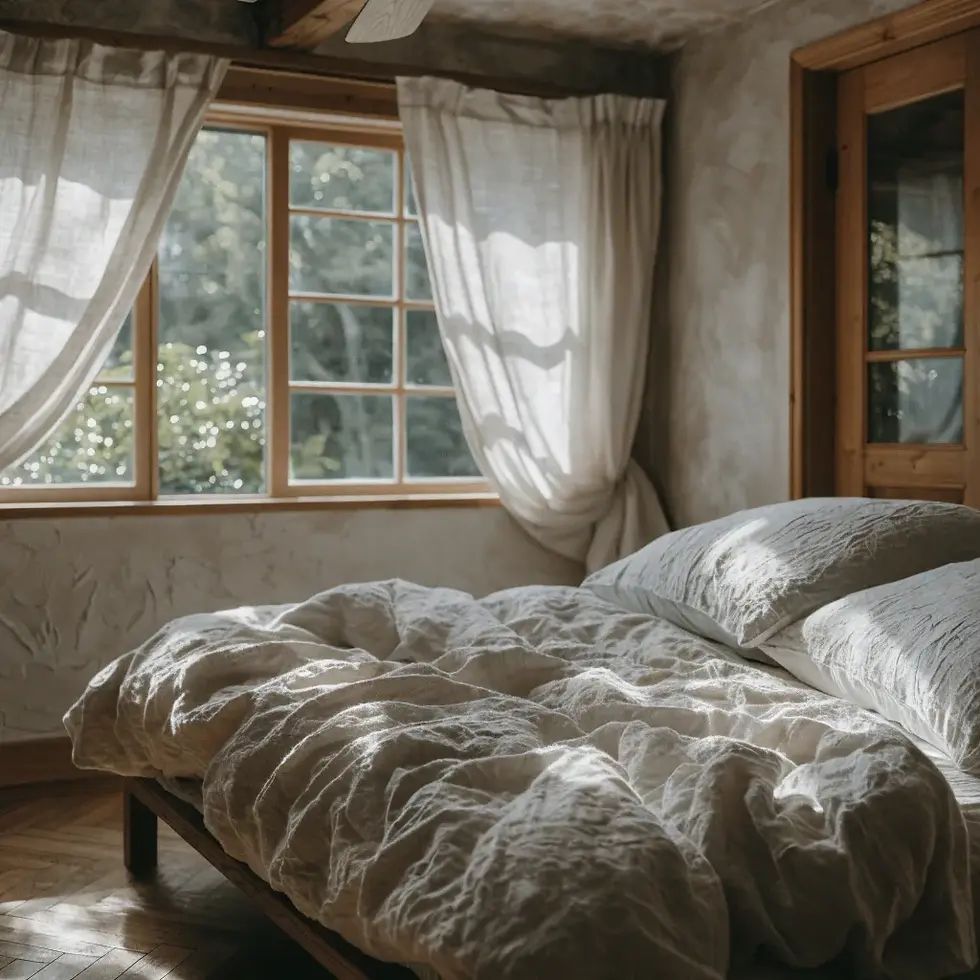
Japandi is a design hybrid Japanese minimalism fused with Scandinavian hygge. It is deliberately refined, clean-lined, and considered. Surfaces are smooth. Furniture is precise. The overall effect is polished and resolved. A Japandi room looks like it was designed by an architect who took great care.
Wabi-Sabi is more raw, more organic, and less resolved. It doesn't avoid irregularity it gravitates toward it. A Wabi-Sabi room looks like it accumulated meaning over time. The clay vessel on the shelf was made by hand, not chosen for perfect proportions. The wall has texture because it was lime-plastered, not because a textured wallpaper was specified. Nothing is trying to be perfect.
The simplest way to hold the distinction: Japandi is curated. Wabi-Sabi is honest.
Both are valid and deeply liveable. But designing for one while believing you're achieving the other produces rooms that feel like neither.
The Materials of Wabi-Sabi: Raw, Biophilic, and Time-Touched
Travertine Stone Travertine is limestone with holes in it. Those holes are not defects; they are the record of gas escaping during the stone's formation millions of years ago. A travertine floor or countertop carries geological time into a domestic space. Polished travertine moves toward Japandi , unfilled, honed travertine is pure Wabi-Sabi.

Live-Edge Wood A table or shelf that follows the natural contour of the tree rather than being cut to a straight edge retains the memory of the organism it came from. No two pieces are identical. The asymmetry is the point.
Raw Clay and Terracotta Unfired or lightly fired clay surfaces wall finishes, vessels, floor tiles absorb light rather than reflect it, creating the matte, grounded atmosphere that Wabi-Sabi rooms are known for. Clay is also one of the most genuinely sustainable materials available: it is abundant, recyclable, and produces no toxic byproducts.
Unbleached Linen and Undyed Wool Natural textiles in their unprocessed state carry the color of the fiber itself warm oat, flax, greige, and muted sand. These tones shift under different light conditions throughout the day, giving a room subtle life without any designed intervention.
Aged Metal Brass that hasn't been lacquered will oxidize. Copper will patina. Iron will rust at the edges. In Wabi-Sabi design, this aging is not a failure of maintenance it is the material becoming more itself over time.
Designing for Stillness: Wabi-Sabi and Mental Wellness
There is a reason Wabi-Sabi has gained significant cultural momentum in the current moment. We are living through a design era dominated by overstimulation screens in every room, surfaces optimized for social sharing, interiors that perform rather than inhabit
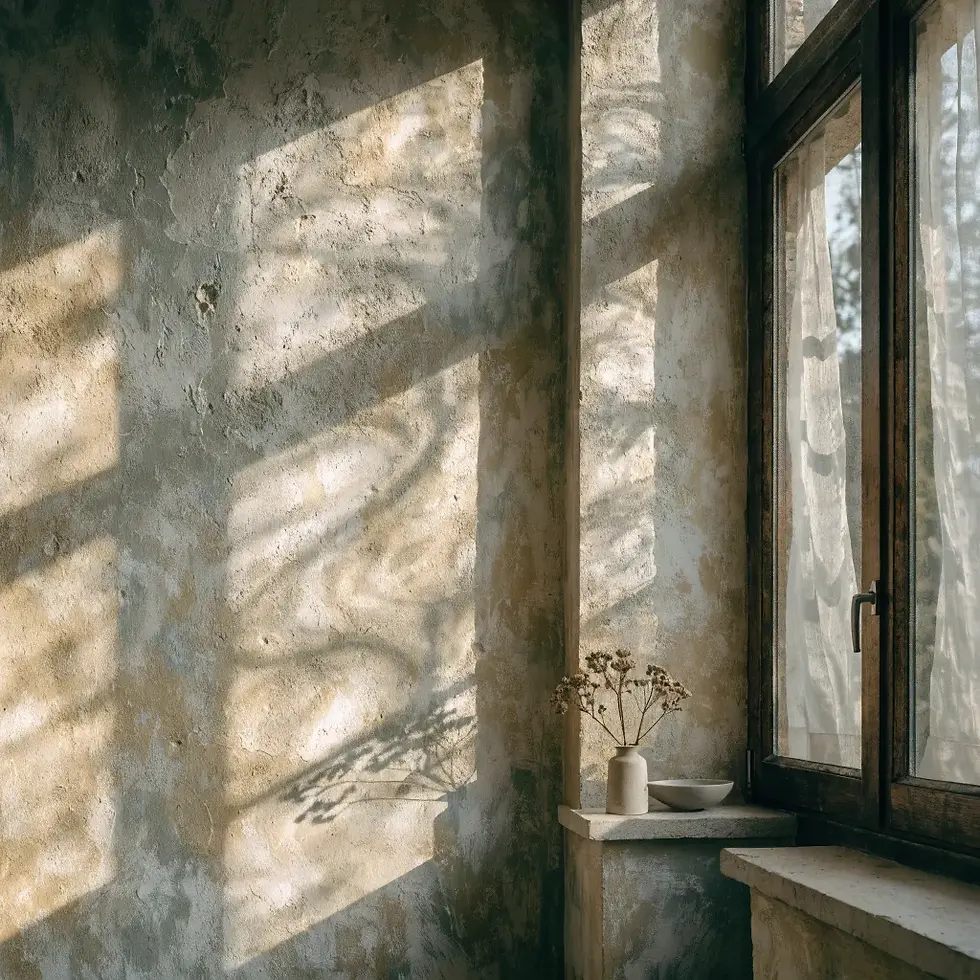
Environmental psychology research supports what Japanese culture has understood for centuries: exposure to natural materials, organic form, and visual complexity that mimics nature activates the parasympathetic nervous system the state of rest, repair, and reflection. The biophilic design principles that have emerged from this research align almost entirely with Wabi-Sabi material choices.
A Wabi-Sabi home is not just beautiful to look at. It is a different way to be inside a space.
How to Begin: Three Entry Points

Start with one surface: Limewash a single wall. Let it dry, live with it for a week. Observe how the light changes it throughout the day. This is the fastest way to understand what the philosophy feels like in your own home.
Remove what has no weigh: This is not the same as minimizing. It means asking, honestly, which objects carry meaning and which are filling space. The ones with no answer are the ones to let go.
Repair before replacing: The cracked bowl. The scratched table. The worn linen. Give each one the Kintsugi treatment attention rather than disposal. The repair is the story.
Wabi-Sabi is not a destination you arrive at. It is a way of looking that, once learned, changes what you see everywhere including in the things you thought were broken.


Comments