
The Art of the Considered Home: Designing Spaces That Feel Intentional Inside and Out

There's a particular kind of satisfaction that comes from walking into a room or stepping out onto a patio and sensing that every element belongs. Not because everything matches, but because everything means something. Good home design isn't about replicating a catalog page; it's about constructing an environment that reflects how you actually live.
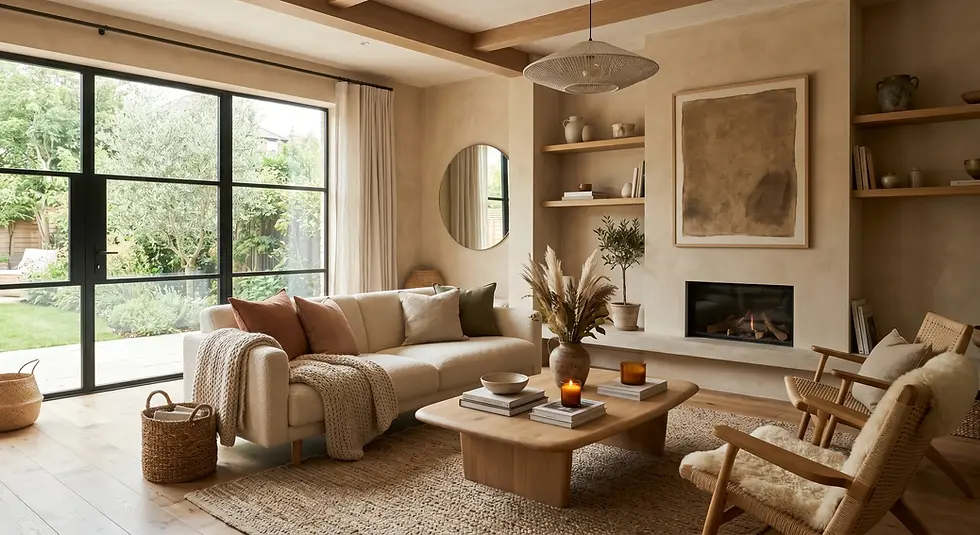
Whether you're rethinking a living room accent wall, refreshing your furniture arrangement, or finally paying attention to the spaces just outside your door, the principles are the same: intentionality, texture, and flow.
Wall Design: The Fifth Element of a Room
Most people think about four walls and a ceiling as boundaries the container for their furniture. But experienced interior designers know that walls are active participants in a room's atmosphere.

Textured wall treatments have surged back into relevance, and not just in the form of wallpaper. Limewash paint a centuries-old Italian technique gives walls a soft, mineral depth that shifts under different lighting conditions. Applied in layers and partially buffed back, it brings an organic, handmade quality that no flat emulsion can replicate. It works beautifully in living rooms, dining spaces, and even bedrooms where you want a sense of quiet warmth.
Fluted wall panels are another element that has found its moment. Originally a detail reserved for architectural columns and cabinetry, vertical fluting applied directly to feature walls adds dimensionality without complexity. In natural oak veneer or painted MDF, these panels create shadow lines that change throughout the day as natural light moves across the room.
For those who prefer something bolder, large-format ceramic tile is no longer confined to bathrooms and kitchens. Oversized stone-effect tiles used on a single living room wall or as a fireplace surround can anchor an entire room's aesthetic especially when paired with low-profile furniture that lets the wall breathe.
Furniture That Earns Its Place
The furniture industry is finally catching up to what discerning buyers have wanted for years: pieces that feel considered, not disposable.

The shift toward curved silhouettes continues. Sofas with rounded arms and arched backs, dining chairs with sculpted seats, side tables with organic edges these forms soften the hard geometry of modern architecture without sacrificing sophistication. They also tend to photograph beautifully, which is why they dominate design publications, but more importantly, they feel good to live with.
Material honesty is another defining trend. Furniture that shows what it's made of solid brass joinery left unlacquered to develop a patina, oak that's oiled rather than lacquered, concrete table tops with visible casting marks signals a shift away from the era of surfaces pretending to be something they're not.
Modular storage systems deserve special mention. Not the flat-pack kind, but properly engineered systems with adjustable shelving, integrated lighting, and mix-and-match door fronts that allow a wall of storage to feel like a piece of furniture rather than a utility fixture. Done well, a full-wall shelving system becomes the most important design statement in a room.
Color as Architecture
Color is where many people play it safe, and where the greatest rewards come from taking measured risks.

Deep, saturated hues forest green, terracotta, indigo, burgundy used on walls and repeated in soft furnishings create a sense of enveloping comfort that lighter palettes simply cannot. The key is treating color as a material: it has weight, it has temperature, it affects how every other surface in the room reads.
Complementary neutrals matter as much as the accent colors themselves. A room anchored in deep sage green needs warm, creamy whites and natural linen tones to breathe. Pair it with too much cool grey and it reads cold. Pair it with aged brass and unbleached cotton and it reads timeless.
Don't overlook the ceiling. A ceiling painted a tone darker than the walls or in a deep contrasting color lowers the perceived height of a room in the best possible way, creating a sense of intimacy and shelter. It's one of the most underused tools in residential design.
The Transition Zones: Where Inside Meets Outside
One of the most neglected opportunities in home design is the threshold the spaces that bridge interior and exterior. Mudrooms, covered porches, entryways, and terraces are often treated as afterthoughts, but they set the tone for everything else.
Flooring continuity is perhaps the most powerful tool here. Using the same large-format tile or natural stone both inside a kitchen and extending outward onto a terrace dissolves the boundary between spaces and makes a home feel significantly larger. Even where materials must change, maintaining a consistent tone or texture preserves the sense of flow.
Outdoor furniture deserves the same thoughtfulness as indoor furniture. Powder-coated aluminium frames with UV-resistant upholstery, solid teak tables that weather beautifully, ceramic-topped bistro sets the outdoor market has matured considerably, and there's no longer any reason to furnish an exterior space with pieces that look like they belong at a public swimming pool.
Outdoor Sweepers: The Understated Tool That Keeps It All Together
A beautifully designed outdoor space whether a terrace in natural stone, a timber deck, or a gravel garden path is only as impressive as its upkeep. And this is where a quality outdoor sweeper earns its place as a genuinely essential tool.

An outdoor sweeper is a motorized or push-operated machine designed to collect leaves, debris, fine grit, and seasonal detritus from hard outdoor surfaces. Unlike a leaf blower, which simply relocates the problem, a sweeper collects and contains leaving a surface that is actually clean, not just temporarily clear.
For homeowners who have invested in textured paving, exposed aggregate driveways, or natural stone patios, a sweeper is particularly valuable. These surfaces trap fine debris in their irregular texture in ways that a standard broom can't address efficiently. A rotary brush sweeper reaches into those recesses, loosening compacted material and gathering it in a single pass.
The better models on the market offer adjustable brush height to accommodate different surface types, large collection hoppers that reduce how often you need to stop and empty, and folding handles for compact storage. Some are walk-behind units suited to larger terraces and driveways; others are compact enough for balconies and smaller patios.
From a design perspective, an outdoor sweeper sits in the same category as a quality garden trowel or a well-made watering can: it's a functional object, but the difference between a surface that's been swept with one and a surface that hasn't is immediately visible. Maintained outdoor spaces feel like deliberate extensions of the home. Neglected ones undermine everything that's been carefully designed indoors.
Keep one stored in the utility area of your garage or in an outdoor cupboard near the terrace. The few minutes it takes to run over a paved surface before guests arrive — or simply on a Sunday morning is one of the smallest efforts with one of the most immediate payoffs in home maintenance.
Putting It Together
Designing a home that feels cohesive from the texture of the walls to the sweep of the driveway is less about having an unlimited budget and more about applying consistent thinking. Ask the same questions in every space: What material is this, and does it belong here? What is this surface doing when the light changes? What will this look like in five years.
The homes that endure the ones that feel genuinely designed rather than merely furnished are the ones where someone asked those questions and answered them honestly. Start with one wall. Move to one room. Eventually, the thinking extends all the way outside, and the whole property begins to feel like a single, considered place.


Comments