
Double the Island, Zero the Stress: The Ultimate Guide to 2026's Most Wanted Kitchen Layout
- DreamDen AI Editorial Team
- Feb 2
- 7 min read

Updated: Feb 4
A double-island kitchen is defined by the presence of two separate, freestanding islands within a single kitchen footprint, each typically serving a distinct functional purpose. While a single oversized island can feel like a vast "continent" that is difficult to navigate, the double-island layout breaks up the mass to improve flow and utility.
It is important to distinguish this from other common configurations:
Not a Peninsula: Unlike a peninsula, which is attached to a wall or cabinetry on one side, both islands in this layout are fully accessible from all sides.
Not an Island + Dining Table: While an island paired with a nearby table is common, a true double-island setup utilizes two built-in or freestanding cabinetry units designed for kitchen tasks.
Not a Single Oversized Island: A single 12-foot island can create a "barrier effect," forcing users to walk long distances to reach the other side. Double islands provide a "pass-through" lane that eases movement.
Real-Life Use Case: In a typical 2026 household, one island may serve as the "Prep Zone," housing a second sink and trash pull-out for active cooking. The second island acts as the "Life Zone," dedicated to casual seating, homework, or serving buffet-style meals during gatherings.
Why Double Islands Became the “Less Stress” Layout

The surge in popularity for double islands in 2026 is driven by a shift from the traditional "Work Triangle" toward "Zone Logic". As kitchens have become the multi-purpose hubs of the home—serving as offices, classrooms, and social centers—a single surface can no longer handle the chaos.
The "Less Stress" secret lies in the Two-Zone Logic:
The Mess Zone: This island is the workhorse. It’s where the chopping, peeling, and dish-loading happen. By keeping the mess contained here, the rest of the kitchen stays presentable.
The Hosting Zone: This island remains clean and "dry." It’s a safe harbor for guests to sit with a glass of wine or for kids to do homework without their laptops being splashed by pasta water.
According to the NKBA/KBIS 2026 Kitchen Trends Report, 53% of designers now prioritize task lighting for specific work zones, reinforcing the move toward these specialized island functions.
Do You Actually Need Two Islands? A Quick Reality Check
Before you commit to a double-island remodel, it is essential to perform a "space and lifestyle" audit. This layout is a luxury of space, and forcing it into a medium-sized kitchen can lead to more stress, not less.
The Decision Checklist:
Square Footage: Do you have at least 15–20 feet of width in your kitchen?
Number of Cooks: Do you frequently have two or more people prepping meals simultaneously?
Entertaining Frequency: Do you host gatherings where people naturally congregate in the kitchen?
Storage Needs: Are your perimeter cabinets overflowing?
The Big Truth: "Double islands feel unnecessary unless the kitchen is truly expansive," If your kitchen isn't large enough to support at least 42-inch aisles between all surfaces, a single island or a peninsula is likely a better fit.
The Best Benefits of Double Islands (Backed by Real Planning Logic)

When executed correctly, the benefits of a double-island layout go beyond mere aesthetics.
More Landing & Prep Space: Two islands provide nearly double the "landing area" for hot pans and grocery bags.
Separation of Tasks: By separating the "wet" tasks (sink) from "dry" tasks (seating), you reduce the risk of cross-contamination and clutter.
Optimized Seating: You can accommodate more guests without them being in the "line of fire" of the stove or oven.
Increased Storage: The additional base cabinets provide room for specialized storage, like wine fridges or microwave drawers.
Resale Value: While a significant investment, high-end features like double islands often attract more buyer interest and can lead to competitive offers in the luxury market.
The Trade-Offs Most People Ignore (So You Don’t)
While the "Pinterest-perfect" photos are tempting, there are real-world trade-offs to consider for 2026.
The "Showroom" Trap: If not styled correctly, two large blocks of cabinetry can feel cold or institutional. Designers are increasingly pushing back on "over-built" kitchens in favor of "human-scale" elements.
Cleaning Surface: Double the island means double the countertop to wipe down. This is why many homeowners choose low-maintenance materials like Cambria Quartz, which requires only warm water and mild soap.
Shrunken Aisles: The most common mistake is sacrificing aisle width to fit a second island, which creates a "clogged" kitchen.
Cost: You are essentially paying for two major pieces of furniture, including cabinetry, countertops, and often additional plumbing and electrical work.
Space Planning Rules That Make or Break a Double-Island Kitchen
To avoid "remodeler’s remorse," you must adhere to the NKBA (National Kitchen & Bath Association) planning guidelines. These are non-negotiable for safety and comfort.
Minimum Clearances Cheat Sheet:
Feature | Minimum Clearance | Recommended for 2026 |
Work Aisle (1 Cook) | 42 inches | 42 inches |
Work Aisle (2+ Cooks) | 48 inches | 48+ inches |
Walkway Width | 36 inches | 42 inches |
Seating (No Traffic) | 32 inches | 36 inches |
Seating (Walk-past) | 44 inches | 48 inches |
Work Aisles: Measured from the leading edge of the countertop to the opposite countertop or appliance. If your dishwasher or oven door is open, you still need room to pass.
Seating Clearance: If people will be walking behind seated diners, you need 44 inches to prevent a bottleneck.
Wheelchair Passage: For an accessible kitchen, a clearance of 60 inches is recommended in at least one "turnaround" area.
The 5 Double-Island Layouts Designers Use Most
Twin/Parallel Islands: Two identical islands placed side-by-side. Best for large, symmetrical, open-concept rooms.

Offset Islands: One island is shifted to the side. Best for L-shaped kitchens or spaces with irregular floor plans.

L-Shaped Arrangement: One island is perpendicular to the other. This creates a natural "corner" for the kitchen that helps define the space in a massive great room.

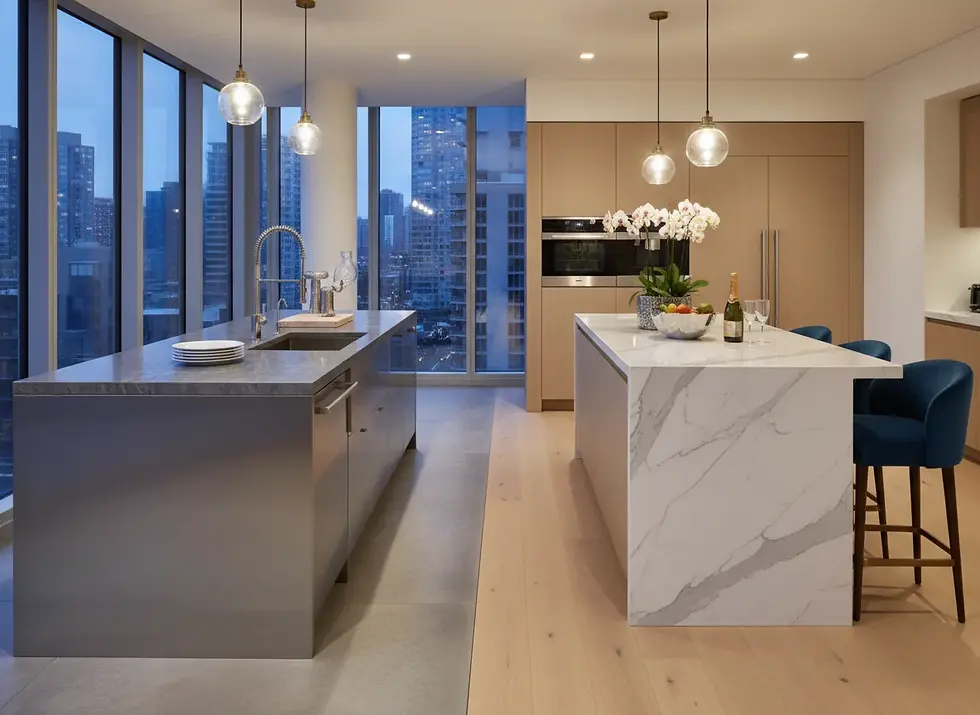
Functional + Social Combo: One island is "all business" with a sink and dishwasher, while the second is a "showpiece" with a waterfall edge and luxury seating.
The "T" Layout: One island serves as the prep area, while a second, lower island is attached in a T-shape to serve as a dining table. (Note: Ensure this is cited as a "split-level" or "table-height" variant).

Avoid this if: Do not use parallel islands if your kitchen is narrow; it will turn your workspace into a series of cramped corridors.
Where Everything Goes: Prep, Cooking, Serving, and Life
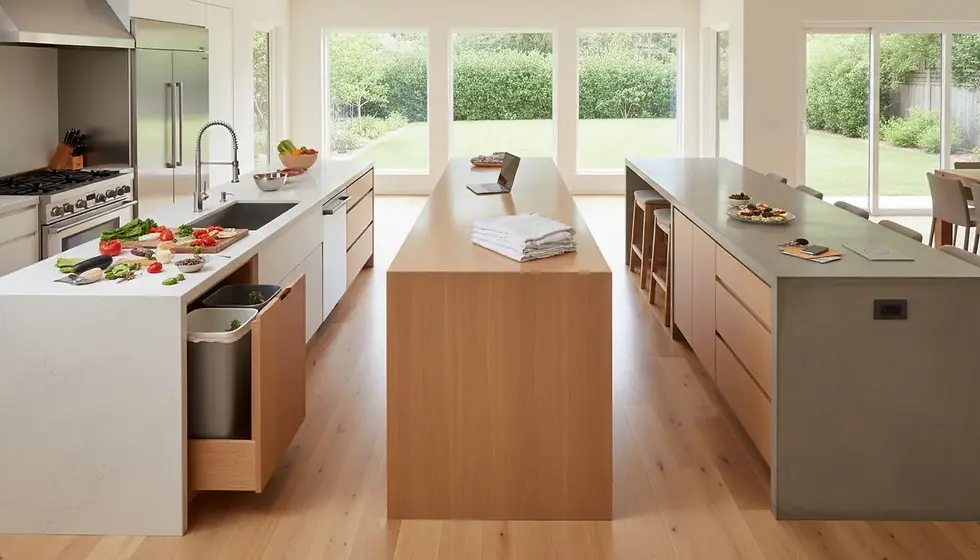
To reduce stress, you need a "map" for your islands.
The Prep Island: Place this closest to the refrigerator and range. It should ideally house the primary or prep sink and a trash/recycling pull-out. This is the "Mess Zone."
The Life Island: This is the "Clean Zone." It should be clear of appliances, providing a vast, flat surface for serving appetizers, folding laundry, or setting up laptops.
The "Drop Zone": One end of the social island often becomes a "drop zone" for mail and keys. In 2026, designers are adding integrated charging ports and "hidden drawers" to manage this clutter.
What Homes (and Floor Plans) Actually Suit Double Islands
Double islands are not a "one size fits all" solution. They are most successful in:
Open-Concept Great Rooms: Where the kitchen needs to "anchor" a large, vaulted space.
Formal Dining Conversions: A common 2026 remodel pattern involves removing a rarely used formal dining room to expand the kitchen footprint, making room for a second island.
Large Multi-Generational Homes: Where multiple people are cooking and eating at different times.
Usually a Bad Fit: Small galley kitchens, enclosed "U-shaped" kitchens, or homes where the kitchen is a separate, isolated room.
Cost, Materials, and “Is It Worth It?”
A double-island kitchen is a high-ticket item. Costs are driven by four main categories:
Cabinetry: You are essentially doubling your base cabinet order.
Countertops: This is often the largest expense. Trends for 2026 favor Quartz and Quartzite for their durability. Cambria quartz is a top choice because it never requires sealing or polishing.
Utilities: Adding a sink or cooktop to an island requires running plumbing, gas, or electrical through the floor, which can significantly increase labor costs.
Lighting: You will likely need two sets of pendant lights or a large linear fixture to balance the two focal points.
Decision Factor: If you plan to stay in your home for 10+ years and value a "zone-based" lifestyle, the investment in functionality often outweighs the initial cost.
If Two Fixed Islands Won’t Work: 3 Smart Alternatives
If your "reality check" in Section 3 was a "no," don't worry. You can still get the vibe with these alternatives:
One Island + Freestanding Worktable: A heavy-duty butcher block table can provide the extra prep space without the permanent footprint of a second built-in island.
One Island + Banquette: Attach a built-in bench to the back of your single island to create a "social zone" without needing a second cabinet run.
Movable Cart: For smaller spaces, a 48-inch or 54-inch rolling kitchen cart from retailers like Home Depot can provide a "pop-up" second island when you're hosting.
Conclusion: Double the Island, Zero the Stress
The double-island kitchen is more than just a luxury statement; it is a response to the way we live in 2026. By separating the "work" of the kitchen from the "life" of the home, this layout creates a calmer, more organized environment.
To prevent regret, remember the 3 Golden Rules:
Respect the Aisle: Never go below 42 inches of clearance.
Define the Zones: One island for mess, one for guests.
Choose Durable Materials: Use surfaces like quartz that can handle the double-duty of a modern kitchen.
Next Step: Talk to a certified kitchen designer or a custom cabinetry specialist to see a 3D rendering of how two islands would fit in your specific floor plan.
FAQ Section
Q: Does a double island increase home value?
A: Yes, in the luxury market, standout features like double islands can attract more buyer interest and higher appraisal values, provided they don't compromise the kitchen's flow.
Q: What is the minimum size for a double-island kitchen?
A: Most designers recommend a kitchen width of at least 15–18 feet to accommodate two islands while maintaining safe NKBA clearances of 42–48 inches for aisles.
Q: Should both islands be the same size?
A: Not necessarily. While "Twin Islands" are a popular symmetrical choice, many 2026 layouts use one larger "Life Island" for seating and a smaller "Prep Island" for cooking tasks.
Q: How do I clean quartz countertops on my islands?
A: For brands like Cambria, you only need warm water, a soft cloth, and mild soap. They are non-absorbent and never require sealing.
Q: Can I put a cooktop on one of the islands?
A: Yes, but it requires careful planning for ventilation. NKBA guidelines recommend powerful vent hoods (85% of 2026 designs) to handle island-based cooking.
Q: Is a double island better than one giant island?
A: For many, yes. Two islands allow for a "pass-through" lane, improving traffic flow and creating distinct zones for mess and social life, which a single giant island can block.


Comments